Why Do Some Engines Have 3 Spark Plugs Per Cylinder? Explained
Are you tired of engine misfires, rough idling, or sluggish throttle response? Many drivers struggle with these issues, especially as engines become more complex and emissions standards tougher.
If you’re curious about ways to boost your engine’s performance, you’re not alone. One interesting solution is engines with three spark plugs per cylinder, which can make a real difference.
Some engines have three spark plugs per cylinder to boost combustion efficiency and power. Multiple igniters create more complete and consistent burns, leading to smoother operation, better throttle response, and lower emissions.
This setup can also reduce misfires and help meet strict environmental standards. If you want to understand how these systems work and why they might become more common, keep exploring how multi-spark setups improve engine performance.
Key Takeaways
- Multiple spark plugs help ensure more complete combustion, which boosts power output and fuel efficiency.
- Having three spark plugs creates several ignition points, reducing misfires and making the engine more reliable.
- They also help optimize ignition timing for different engine loads and speeds, leading to smoother performance.
- Extra plugs contribute to cleaner emissions because they promote a more thorough fuel burn.
- Overall, this design aims to improve engine efficiency, especially in high-performance or specific engine setups.
What Are Multiple Spark Plugs and Why Do Some Engines Use Them?
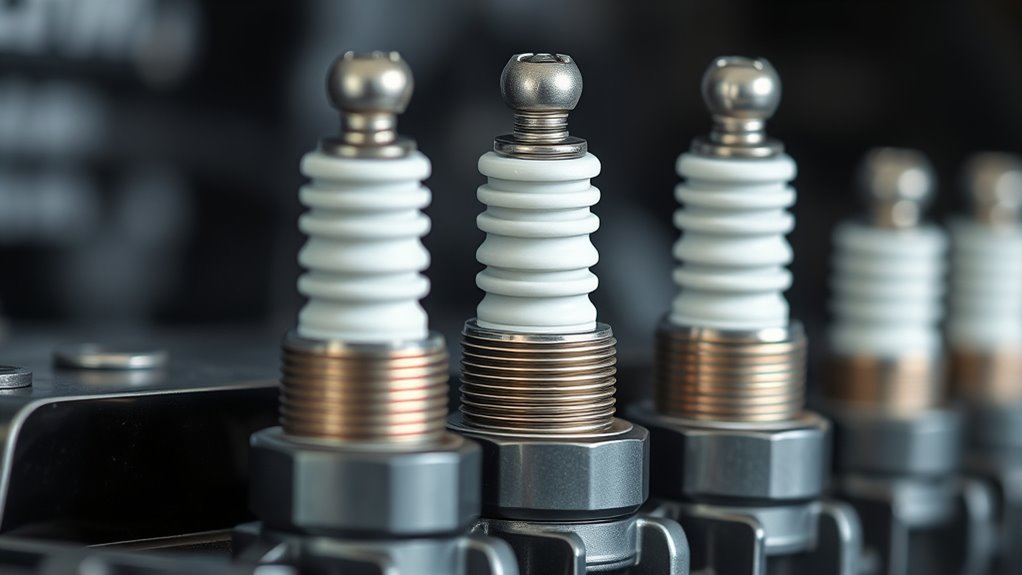
Multiple spark plugs are extra igniters installed in a single engine cylinder, working alongside the primary spark plug. They are part of multiple ignition systems, designed to boost combustion efficiency.
By firing simultaneously or in quick succession, these systems ensure a more complete burn of the fuel-air mixture. This setup offers several advantages, including smoother engine operation, increased power, and lower emissions.
Firing together or rapidly, they improve fuel burn, boosting power, smoothing operation, and reducing emissions.
Multiple spark plugs can also help prevent misfires, especially at high speeds or under heavy loads. Using more than one spark plug per cylinder distributes the ignition process more evenly, leading to better fuel economy and improved performance.
Some engines use this approach to meet strict emissions standards or maximize power. Overall, multiple ignition systems with multiple spark plugs help optimize engine efficiency and reliability, making them popular in high-performance and modern vehicles.
How Do Spark Plugs Work in Combustion Engines?
Ever wondered how spark plugs actually ignite the fuel mixture in your engine? Well, they create a tiny spark right at the perfect moment. This timing is super important because it helps the engine run smoothly and efficiently. Without that spark, the fuel wouldn’t ignite properly, and your engine wouldn’t work as well.
Basically, the spark plug controls when the spark happens during the combustion cycle. When it sparks at just the right time, it causes the fuel mixture to ignite, which powers the engine. So, in a way, these little parts are pretty crucial for keeping your car running smoothly and making sure everything runs without a hitch.
Spark Generation Process
Spark plugs are essential for igniting the air-fuel mixture inside an engine’s cylinders. During spark ignition, the plug creates a high-voltage electrical discharge across its electrodes, producing a spark.
This spark ignites the compressed mixture, starting combustion. The process begins with the ignition coil turning the battery voltage into a much higher voltage, which then travels through the ignition system to the spark plug.
When the high voltage reaches the plug, it jumps the gap between the electrodes, creating the spark. This rapid ignition turns chemical energy into mechanical energy, powering the engine.
Efficient spark generation is crucial for energy efficiency, helping ensure complete combustion and the best power output. Proper spark plug function directly affects engine smoothness, performance, and fuel economy.
Ignition Timing Role
Ignition timing is vital because it determines the precise moment when the spark ignites the air-fuel mixture inside the cylinder, directly affecting engine performance. Proper ignition synchronization guarantees the spark occurs at the ideal point in the combustion cycle, maximizing power and efficiency.
If the timing is off, your engine can experience knocking, reduced fuel economy, or sluggish response. Timing adjustments are important for adapting to different operating conditions, such as engine load or temperature.
When spark plugs fire too early or late, it disrupts the combustion process, leading to poor performance and increased emissions. That’s why understanding and maintaining correct ignition timing helps your engine run smoothly, efficiently, and reliably.
Proper timing guarantees each spark ignites at just the right moment for optimal power delivery.
Combustion Cycle Function
In a combustion engine, spark plugs play an essential role by igniting the air-fuel mixture at just the right moment to power the engine. This ignition starts the combustion cycle, turning fuel into mechanical energy.
Proper spark timing is key to maximizing combustion efficiency and aligning with engine design to boost power output. When the spark ignites the mixture, it creates a controlled explosion that pushes the piston downward.
This movement turns the crankshaft, which powers your vehicle. Different engine designs might use multiple spark plugs to ensure complete combustion across the cylinder.
Here’s a quick overview:
| Step | Description | Result |
|---|---|---|
| Combustion Start | Spark ignites the air-fuel mixture | Piston moves downward |
| Power Stroke | Explosion drives piston down | Generates engine power |
| Exhaust | Expels burned gases | Clears cylinder for next cycle |
How Do Multiple Spark Plugs Improve Engine Efficiency and Power?
Multiple spark plugs in a cylinder can significantly boost engine efficiency and power by promoting a more complete and consistent combustion process. When each plug ignites the air-fuel mixture either simultaneously or in a carefully timed sequence, it improves spark efficiency and helps achieve a more uniform burn.
This better combustion process allows the engine to extract the maximum energy from the fuel, directly increasing power by producing more work per cycle. With multiple sparks, the combustion spreads more evenly across the chamber, which reduces the chances of misfires or incomplete burns.
As a result, your engine runs smoother, delivers more power, and consumes less fuel. Plus, improved spark efficiency minimizes hotspots and uneven pressure inside the cylinder, further enhancing overall engine performance.
Do Multi-Spark Systems Reduce Emissions and Help Meet Regulations?
By improving the combustion process with multiple spark plugs, engines can produce cleaner exhaust gases. This better combustion helps reduce emissions, making it easier to meet strict environmental rules.
Multi-spark systems create more complete combustion, cutting down on unburned fuel and harmful pollutants like NOx and particulate matter. As a result, your engine emits fewer toxic gases, helping you stay within legal limits.
Multi-spark systems improve combustion, reducing pollutants and harmful gases to help your vehicle meet emissions standards.
Many automakers use these systems to ensure their vehicles pass emission tests and comply with regulations. This not only benefits the environment but also helps you avoid fines and recalls.
Cleaner emissions also mean better air quality and public health. While multi-spark systems might add some complexity and cost, their benefits for emissions and regulatory compliance usually outweigh those concerns.
Which Types of Engines Use Three Spark Plugs Per Cylinder?
Certain high-performance or specialized engines incorporate three spark plugs per cylinder to optimize combustion and power output. These engine types often include racing engines, high-performance sports cars, and some aircraft engines, where maximizing efficiency and power is essential.
The spark plug configurations are designed to guarantee complete combustion by igniting the fuel-air mixture at multiple points within the cylinder. This setup helps improve throttle response, fuel efficiency, and emissions control, especially under demanding conditions.
Multi-spark systems are also common in engines with larger combustion chambers or complex valve arrangements, where a single spark might not ignite the mixture evenly. You’ll typically find these configurations in engines that push the boundaries of traditional design, where performance takes precedence over cost or simplicity.
What Are the Challenges of Installing Multiple Spark Plugs in a Single Cylinder?
Installing multiple spark plugs in a single cylinder can be pretty tricky because it needs a pretty complex setup, and space is often limited. It’s not just about fitting them in; you also have to think about how everything will work together without crowding the engine.
Plus, having more spark plugs means more parts to maintain, which can lead to increased maintenance needs. More components also mean there’s a higher chance of something going wrong somewhere down the line.
And let’s not forget, the engine design has to be carefully planned out to fit those extra plugs without messing up performance or safety. All in all, it’s a bit of a balancing act!
Complex Installation Process
Adding multiple spark plugs to a single cylinder really complicates the installation process. It requires precise adjustments and careful handling throughout.
First, fitting three spark plugs means the cylinder head needs to be accurately machined to fit all components without interference.
Second, ensuring proper spark plug spacing is crucial to prevent misfires and optimize engine performance.
Third, routing the spark plug wires or coils becomes trickier because tight clearances must be maintained to avoid contact or electrical issues.
These challenges highlight the need for careful planning and precision during installation. The increased complexity makes understanding the engine’s design and executing the process carefully essential for reliable performance.
Increased Maintenance Demands
Having multiple spark plugs in a single cylinder greatly increases maintenance needs, making routine checks and replacements more time-consuming and complex. You’ll need to check each spark plug’s condition separately, which can impact how long they last and how well the engine runs.
With more parts to inspect, clean, or replace, maintenance becomes more frequent. Since each spark plug operates in a slightly different environment, some may wear out faster and need more attention. This adds to the complexity and the chance of improper installation or uneven wear.
These issues can affect engine efficiency, so maintaining engines with multiple spark plugs requires more careful attention and precision. Overall, this often leads to higher maintenance costs and longer service times.
Space and Design Constraints
The compact space inside a cylinder makes it tricky to fit multiple spark plugs. You need to balance the placement with space optimization, which can be quite challenging.
Installing more plugs requires careful planning so they don’t interfere with other engine parts. The main challenges include limited physical space and the risk of heat buildup.
You also have to deal with complex wiring and connections. More plugs mean more wiring, which can increase the chance of misfires.
Plus, the cylinder head must be designed to hold multiple spark plugs without sacrificing durability or airflow. All these factors push engineers to optimize the engine layout carefully.
They need to ensure that multiple spark plugs work efficiently within tight spaces while keeping the engine performing well.
Are Multi-Spark Plug Engines Better Than Traditional Single-Plug Engines?
Multi-spark plug engines often outperform traditional single-plug engines in efficiency and power, especially under tough conditions. The multiple sparks help achieve more complete combustion, which boosts both performance and fuel economy.
Having several sparks creates a more uniform flame front, reducing misfires and making sure the fuel-air mix burns thoroughly. This results in more power and smoother operation overall.
You’ll notice better throttle response and lower emissions, making these engines more eco-friendly. Plus, multi-spark systems can help prevent knocking, allowing for more aggressive ignition timing and better performance at higher loads.
Do Multiple Spark Plugs Increase Maintenance Costs or Affect Reliability?
While multi-spark plug systems boost engine performance and efficiency, they can also impact maintenance costs and reliability. Usually, more spark plugs mean higher expenses because you’ll need to replace and service multiple parts.
This can lead to increased maintenance costs over time. Plus, the complexity of multi-spark systems raises some reliability concerns:
- More parts to fail – With extra spark plugs and wiring, there’s a higher chance of faults cropping up.
- Increased servicing complexity – Replacing and aligning multiple plugs takes longer and requires more precision.
- Potential for inconsistent firing – If one plug malfunctions, it can affect overall engine performance and reliability.
Will Multi-Spark Engines Be the Future of Automotive Design?
So, multi-spark engines might actually be the next big thing in car design. They could make combustion more efficient and help cut down emissions, which is pretty exciting for future vehicles. Imagine engineers using multiple sparks to get the most out of fuel and boost overall performance.
As technology keeps advancing, these engines could really change how car makers think about engine design and sustainability. It’s like a step toward more eco-friendly and efficient vehicles, and who knows—maybe we’ll see them becoming pretty common in the not-so-distant future.
Enhanced Combustion Efficiency
Advances in ignition technology aim to improve how efficiently an engine burns fuel, and multi-spark systems are leading the way. They create multiple ignition points in a single cycle, leading to more complete and controlled burns.
This results in several benefits. First, faster combustion occurs because multiple sparks ignite the mixture at once, reducing the time needed for the fuel to burn completely.
Second, it helps reduce knocking by giving better control over ignition timing, which protects engine components.
Finally, more complete combustion extracts the maximum energy from the fuel, boosting overall efficiency.
Potential Design Innovations
As automotive engineers explore new ways to improve engine performance and efficiency, multi-spark ignition systems are gaining attention as a promising innovation. These systems create multiple ignition points within a single cycle, helping to promote more complete combustion.
Advances in ignition technology allow for better control over spark timing and energy distribution, which leads to more consistent engine performance and lower emissions.
In the future, car designs might include multi-spark systems to boost fuel efficiency and power, especially in high-performance and eco-friendly vehicles.
By refining ignition system tech, automakers could develop engines that run smoother, consume less fuel, and are more reliable.
Multi-spark engines could soon become a standard feature, transforming how cars are designed and built.
Summary: Are Three Spark Plugs Per Cylinder the Next Step in Engine Technology?
Could three spark plugs per cylinder become the future of engine design? It’s possible, especially as engine tech and spark technology improve. Using multiple spark plugs can boost combustion efficiency, cut emissions, and increase power. Here’s what to consider:
- Enhanced combustion – Multiple plugs help ignite the fuel-air mixture more evenly, leading to better performance.
- Lower emissions – More precise ignition burns fuel more completely, reducing pollutants.
- Increased reliability – Modern spark technology might make multi-plug setups more durable and affordable.
While this setup offers clear advantages, it also adds complexity and cost. Car manufacturers will need to weigh these factors against the benefits in efficiency and power.
As engine tech advances, especially in spark systems, the idea of three plugs per cylinder could become more common. Still, widespread adoption will depend on whether the benefits outweigh the challenges for both makers and drivers.
Frequently Asked Questions
How Does the Ignition Timing Differ With Multiple Spark Plugs?
With multiple spark plugs per cylinder, the ignition timing is usually synchronized to boost ignition efficiency and combustion stability.
You’ll see the sparks fire either at the same time or in a sequence, making sure the combustion is complete. This setup helps cut down on misfires, especially at high speeds or under heavy loads.
Are Multi-Spark Systems More Common in High-Performance Engines?
Yes, multi-spark systems are more common in high-performance engines because they offer significant performance benefits. They improve ignition efficiency by creating multiple sparks within a single cycle, making sure the fuel burns completely.
This leads to smoother power delivery, better fuel economy, and lower emissions. If you want improved engine responsiveness and efficiency, multi-spark systems are a smart choice, especially in high-performance applications where good combustion is key.
What Materials Are Used for Multi-Spark Plug Electrodes?
Imagine tiny bridges sparking across a river—your spark plug electrodes connect like that in your engine. They’re made from durable materials like platinum, iridium, or nickel alloys, designed for longevity and efficient ignition.
Spark plug design influences electrode material choices, ensuring reliable sparks even under extreme heat and pressure. These materials help maintain perfect spark stability, optimizing engine performance and fuel efficiency.
It’s a bit like skilled architects reinforcing a bridge for smooth, unwavering crossings.
Can Multi-Spark Plugs Improve Engine Cold Start Performance?
Yes, multi-spark plugs can improve your engine’s cold start performance. They create multiple ignition points, which helps ensure a more reliable and complete combustion process.
This means your engine can start more smoothly and quickly in low temperatures. With better ignition, you’ll notice less rough idling and more reliable starts during cold weather.
Do Multi-Spark Systems Require Specialized Ignition Modules?
Yes, multi-spark systems do require specialized ignition modules. These modules are built to handle multiple sparks per cycle, which boosts ignition efficiency and improves spark plug performance.
By producing multiple sparks, the system ensures a more reliable ignition of the fuel-air mixture, especially during cold starts or when the engine is under heavy demand.
This specialized setup helps improve engine performance and efficiency, making the ignition process more effective than standard single-spark systems.
Conclusion
In the race for better engine performance, three spark plugs per cylinder act like a symphony conductor, orchestrating smoother, more efficient combustion. While they can boost power and reduce emissions, they also add complexity and maintenance.
Whether they become the standard or fade away depends on future innovations. Ultimately, embracing multi-spark technology might be the engine’s next leap forward, turning the ignition of progress into a blazing trail.
This setup highlights why some engines have three spark plugs per cylinder—it’s all about pushing the limits of performance and efficiency.