What Is in a Battery Charger: Key Components Explained
Are you tired of dealing with dead batteries or constantly replacing your chargers? Many people struggle with understanding what goes on inside a battery charger, which can make choosing the right one confusing. If you want to get the most out of your devices, it helps to know what’s happening behind the scenes.
A battery charger has key parts like a transformer to step down voltage, rectifiers to turn AC into DC power, and capacitors to smooth out fluctuations.
Voltage regulators keep the current safe and steady. You’ll also find safety features like fuses and indicators to alert you of issues.
Power flow is controlled by switches and control circuits.
If you want to understand how each component works together, keep exploring the details behind these important elements.
Key Takeaways
- A transformer adjusts the incoming voltage to safe levels for charging.
- Rectifiers convert AC to DC, with types like half-wave, full-wave, and bridge rectifiers.
- Voltage regulation components help keep the current steady and safe for the battery.
- Safety features such as fuses, overcurrent, and short-circuit protection prevent damage or hazards.
- Control circuits and indicators keep an eye on the charging process to ensure it’s safe and efficient.
What’s Inside a Battery Charger?
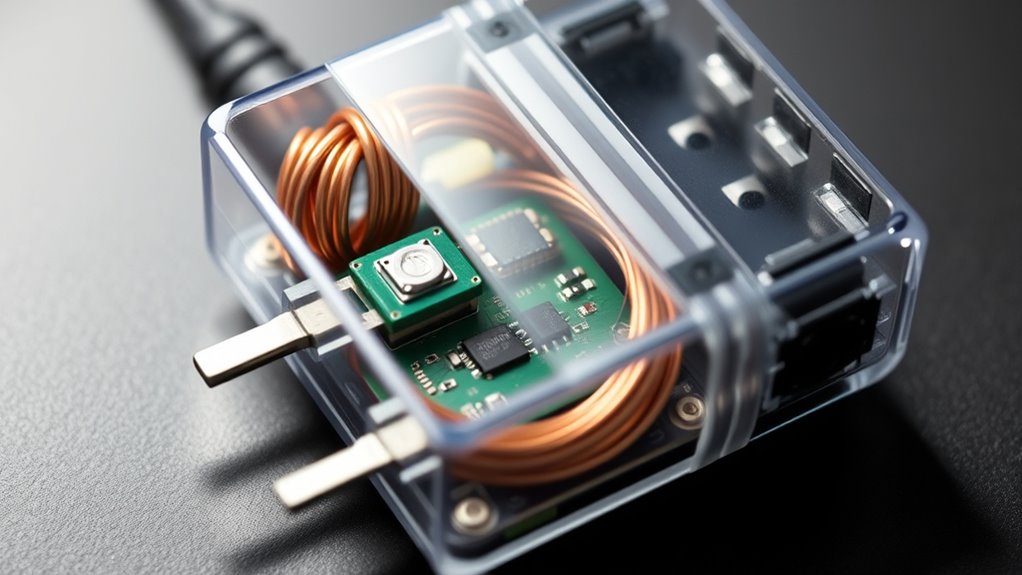
A battery charger is made up of several essential components that work together to restore power to your batteries. At its core, the transformer adjusts the incoming voltage to a safer level, supporting ideal battery technology.
The rectifier converts alternating current (AC) to direct current (DC), which is necessary for charging batteries efficiently. A control circuit manages the charging process, ensuring charger efficiency by regulating current flow and preventing overcharging.
The rectifier transforms AC to DC, while the control circuit ensures efficient, safe charging by regulating current and preventing overcharging.
The display or indicator lights provide real-time feedback on the charging status. Inside, resistors and capacitors work to smooth out voltage fluctuations, maintaining stable power delivery.
These components must be precisely designed to match the battery’s chemistry, as different battery technologies require specific charging profiles. Overall, the quality and integration of these parts determine how effectively your charger restores power, emphasizing the importance of quality components for safer, more efficient charging.
How Does a Power Supply Convert Electricity for Charging?
Sure! When you plug in your charger, the power supply first takes the AC electricity from the wall outlet and converts it into DC electricity. This step is important because your devices usually need DC to function properly.
Next, it adjusts the voltage to make sure it’s just right—neither too high nor too low—so your device charges safely and smoothly. Finally, the power supply carefully controls the amount of energy it sends to your device, making sure it gets enough to charge quickly without overloading.
AC to DC Conversion
Since most household outlets supply alternating current (AC), power supplies need to convert this into direct current (DC) that’s suitable for charging batteries. The process starts with rectification, where the AC waveform is turned into a pulsating DC signal, which can cause DC ripple.
To reduce ripple and boost efficiency, advanced circuit design and filtering are crucial. Good power factor and harmonic analysis help cut energy loss and electromagnetic interference.
Managing voltage drops involves thermal management and selecting the right components to meet safety standards. Load regulation is also important to keep the output steady even as the load changes.
Finally, proper design considers thermal dissipation and circuit protection, ensuring the power supply is stable, efficient, and safe for charging batteries effectively.
Voltage Regulation Process
Voltage regulation is a key step in making sure the power supply provides a stable and consistent voltage level for charging batteries. It helps prevent overcharging and damage by keeping the voltage steady, no matter how much input power or load changes.
You’ll see voltage stabilization techniques like linear regulators or switching regulators playing a major role here. These components smooth out voltage fluctuations, ensuring a reliable current is delivered.
Adaptive voltage management takes it even further by adjusting the output dynamically based on the battery’s state and charging needs. This process helps ensure safety, efficiency, and a longer battery life.
Power Flow Control
Power flow control in a battery charger determines how electrical energy is directed from the power source to the battery. It manages the power management process to boost charging efficiency and prevent overcharging. Your charger uses components like switches, rectifiers, and controllers to regulate this flow.
Proper control guarantees the right amount of current reaches the battery at each stage. To understand better, consider these key points:
- Current regulation: Adjusts the flow of electricity for safe and efficient charging.
- Switching components: Enable quick on/off control to maintain ideal power transfer.
- Feedback systems: Keep an eye on battery status to refine power delivery.
This dynamic control maximizes charging efficiency while protecting the battery’s health.
What Is the Role of the Transformer in a Charger?
A transformer is an important part of a charger that makes sure your device gets the right amount of electrical energy. Its main job is to change the voltage level, either stepping it up or down, based on what your device needs.
There are different types of transformers, like laminated core transformers used in traditional chargers and toroidal transformers in smaller designs. Their main functions are voltage regulation and isolation.
By lowering high-voltage AC from the power outlet to a safer, lower voltage, the transformer protects your device from damage caused by excess power. It also isolates your device from the main power supply, which reduces electrical noise and makes things safer.
Transformers lower high-voltage AC, safeguarding devices and reducing electrical noise for safer, more reliable charging.
Without a transformer, your charger wouldn’t be able to convert power effectively. In short, it acts as a vital bridge, ensuring your device gets the right voltage and safety features for efficient charging.
How Do Rectifiers Turn AC Into DC Power?
You might be curious about how rectifiers turn AC into DC power, especially when you’re charging your devices. Basically, rectifiers use special components that only let current flow in one direction, which is how they convert the alternating current (AC) into direct current (DC). It’s like they act as one-way valves for electricity.
There are different types of rectifiers, and each works a bit differently, but they all serve the same purpose. Understanding how these rectifiers do their job can really help you get a clearer picture of how your chargers and power supplies work behind the scenes.
Rectifier Functionality Explained
Rectifiers are key parts of battery chargers because they turn AC into DC, which batteries need to charge. They work by letting current flow in only one direction.
There are different types of rectifiers, like half-wave, full-wave, and bridge rectifiers. Each one is used for different applications depending on the needs.
Here’s how they work:
- Half-wave rectifiers block one half of the AC cycle, producing pulsating DC.
- Full-wave rectifiers use both halves of the cycle, giving a smoother DC output.
- Bridge rectifiers use four diodes to convert AC to DC more efficiently with less ripple.
Knowing these types helps you understand how rectifiers fit into different charger designs.
Types of Rectifiers Used
There are three main types of rectifiers used to convert AC into DC power: half-wave, full-wave, and bridge rectifiers. Each uses different diode types, with silicon diodes being most common, though Schottky diodes are used for higher efficiency.
Rectifier efficiency varies based on bridge configurations and switching rectifiers, which impacts overall performance. Full-wave and bridge rectifiers provide better ratings and higher efficiency by utilizing both halves of the AC cycle.
They are versatile for different applications, especially when a smooth DC output is needed. Phase control is often added to adjust the output voltage, while thermal management ensures diodes operate safely.
Understanding these rectifier types helps optimize design by balancing ratings, efficiency, and thermal performance in your charger.
Conversion Process Details
When AC voltage is applied to a rectifier circuit, diodes act as electronic switches that allow current to flow in only one direction. This process converts AC into pulsating DC, which is essential for safe battery charging. The conversion impacts battery chemistry and charging efficiency, as smooth DC leads to better charge control. To improve this, filters and smoothing circuits are added to reduce voltage ripple.
- Rectification: Diodes block negative cycles, producing unidirectional current.
- Filtering: Capacitors smooth pulsating DC, enhancing charging efficiency.
- Regulation: Voltage regulators guarantee consistent current suited to battery chemistry.
Together, these steps maximize charging efficiency and protect the battery from damage, ensuring peak performance and longevity.
Why Are Capacitors Important for Stable Charging?
Capacitors play a crucial role in guaranteeing a stable charging process by smoothing out fluctuations in voltage. They act as buffers, absorbing sudden surges or dips that could otherwise damage your device or reduce charging efficiency.
Different capacitor types, such as ceramic, electrolytic, and film capacitors, are chosen based on their ability to handle specific voltage and frequency requirements. Using the right capacitor type improves charging efficiency by maintaining a steady voltage supply, which prevents interruptions or slowdowns during charging.
Without capacitors, voltage fluctuations could cause inconsistent current flow, leading to longer charging times and potential damage to your battery. By stabilizing the power supply, capacitors contribute to a safer, more reliable charging process.
They fundamentally guarantee that your device receives a consistent, smooth current, maximizing battery lifespan and overall performance. That’s why capacitors are crucial components in any effective battery charger design.
How Do Semiconductors Regulate Power in Chargers?
Semiconductors are key players in controlling and adjusting the power flow inside chargers, making sure your device gets the right voltage and current. They work as switches and amplifiers, providing precise regulation.
Semiconductors precisely control power flow to ensure safe and efficient device charging.
This helps improve efficiency by reducing energy loss during charging. Semiconductors also help manage heat, preventing overheating by adjusting current based on temperature feedback.
Here are three main ways they regulate power:
- Switching: Semiconductors quickly turn power on and off to control how much energy reaches your device.
- Voltage Regulation: They adjust voltage levels to match what your device needs, avoiding overcharging or damage.
- Current Control: Semiconductors modulate the flow of current to speed up charging and protect your battery.
How Do Voltage Regulators Keep Charging Safe?
Voltage regulators help keep the charging process safe by making sure the voltage going into your battery isn’t too high. Think of them as a kind of gatekeeper that keeps things in check. If the voltage starts to rise too much, they automatically step in and reduce the power flow, so your device doesn’t get overwhelmed.
This way, they prevent overvoltage situations that could damage your battery or device. It’s like having a safety net that ensures your device gets just the right amount of power. In the end, this helps your battery stay healthy and charged efficiently, without any worries.
Voltage Regulation Mechanism
To keep charging safe, voltage regulators play an essential role by constantly adjusting the flow of current to match the battery’s needs. This helps keep the voltage stable and prevents overcharging or damage.
They ensure charger efficiency by delivering consistent voltage levels, even when input power fluctuates. Here are three key points:
- Dynamic Adjustment: Voltage regulators monitor the output voltage and instantly tweak the current to keep the voltage steady.
- Feedback Control: They use feedback loops to detect any voltage changes and respond quickly, making sure charging stays safe and efficient.
- Protection Against Fluctuations: They filter out electrical noise and transient spikes to maintain voltage stability during charging.
This mechanism is crucial for safe, efficient battery charging, which helps maximize the battery’s lifespan and performance.
Overvoltage Protection Role
Overvoltage protection is essential for keeping your battery charger safe by preventing too much voltage from damaging the battery.
Risks like voltage regulation failure or power surges can cause overvoltage, which may harm your battery or shorten its lifespan.
To prevent this, chargers include protection features like overvoltage shutoff circuits or surge protectors.
These systems constantly monitor voltage levels and quickly disconnect power if the voltage gets too high.
This ensures your battery only receives the right amount of voltage, avoiding overheating, swelling, or permanent damage.
Stable Charging Process
Because fluctuations in power can disrupt the charging process, voltage regulators actively maintain a steady voltage level to guarantee safety and efficiency. This stability improves charging efficiency and prevents damage to your device.
Voltage regulators also support thermal management by reducing heat buildup caused by voltage spikes. This helps prolong your charger’s lifespan.
To understand their role better, consider:
- Voltage stabilization – Prevents overcharging and protects your device’s battery.
- Improved charging efficiency – Maintains ideal power flow for faster, safer charging.
- Thermal management – Reduces heat generated during charging, safeguarding components.
What Are the Main Charging Cables and Connectors?
In relation to charging devices, understanding the main cables and connectors is essential for guaranteeing compatibility and safety. Different charging standards dictate which connector types you’ll encounter, such as USB-C, Micro USB, or Lightning, each with unique connector designs.
The cable materials—like copper or fiber-optic cores—impact durability and charging speeds. Compatibility issues can arise if your device’s port doesn’t match the cable’s connector type, leading to slower charging or no connection at all.
Safety certifications guarantee the cables meet standards for preventing overheating or short circuits. Cable lengths vary, affecting convenience and portability, while connector designs influence how securely the cable fits into your device.
Knowing these factors helps you select the right cables for your needs, maximizing safety, efficiency, and device protection. Being familiar with these aspects guarantees you avoid common pitfalls and get the most out of your charging setup.
How Do Indicators and Safety Features Protect Your Devices?
Ever wonder how your charger keeps your devices safe during every use? It all comes down to indicator types and safety mechanisms built into the charger. These features alert you to issues and prevent damage.
- LED indicators show charging status, letting you know if your device is charging, fully charged, or if there’s a problem.
- Overcurrent protection automatically cuts power when too much current flows, preventing overheating or damage.
- Short-circuit protection shuts off power if a fault occurs, avoiding potential fires or device harm.
These safety features work together to monitor and control the charging process. Indicator types provide real-time feedback so you’re always aware of your device’s status. Safety mechanisms guarantee that even if something goes wrong, your device stays protected and safe from electrical issues. This combination gives you peace of mind during every charge.
Common Troubleshooting Parts in a Charger and How to Fix Them
When your charger stops working properly, identifying common troubleshooting parts can help you diagnose and fix the issue quickly. Start by checking the power cord and AC adapter, since damage here can disrupt the power supply.
The fuse is another key part; a blown fuse prevents charging and needs replacing. Inspect the circuit board for burnt components or corrosion, which can interfere with battery maintenance.
Compatibility issues may also cause problems, so make sure your charger matches your device’s specifications. Finally, examine the charging port for dirt or damage, as poor contact hampers charging.
Frequently Asked Questions
How Do Different Battery Types Affect Charger Design?
Different battery types, based on their chemistry, greatly influence charger design. You’ll notice that chargers need specific features to optimize charging efficiency for each chemistry, like lithium-ion, NiMH, or lead-acid.
For example, lithium-ion chargers incorporate precise voltage controls to prevent overcharging, while lead-acid chargers have different current requirements. These variations guarantee safe, efficient charging tailored to each battery’s chemistry, ultimately enhancing performance and longevity.
Can Chargers Work With Multiple Device Brands?
Imagine you’re using a universal charger for your smartphones and tablets. This charger works with multiple device brands because it supports universal compatibility and adapts to different brand-specific technology.
Many chargers today are designed to work across various devices, but some still require brand-specific technology for peak performance. So, while some chargers can work with multiple device brands, always check for compatibility to guarantee safe and efficient charging.
What Environmental Factors Impact Charger Longevity?
Environmental factors really affect how long your charger lasts. If it’s exposed to extreme temperatures, whether too hot or cold, it can damage the internal parts and shorten its life.
Humidity can cause corrosion and lead to short circuits, and dust build-up blocks ventilation, which can cause overheating. Heavy or inconsistent use also puts extra stress on the charger.
To help it last longer, keep it in a cool, dry place, clean off dust regularly, and avoid overusing or mishandling it.
Are There Wireless Charging Components Involved?
While wireless technology is often seen as a modern convenience, it does involve specialized components like coils and receivers that help with contactless charging.
These components improve charging efficiency, making the process smoother and more adaptable.
But they also need careful alignment and can be sensitive to environmental factors.
This subtly reminds you that even the most advanced wireless systems depend on precise conditions to work well.
How Do Smart Chargers Detect When a Device Is Fully Charged?
You can tell when a smart charger detects a device is fully charged through its advanced charging algorithms and voltage regulation. The charger keeps an eye on the device’s voltage and current, adjusting its output as needed.
When it senses that the battery has reached its ideal charge level, the algorithms either slow down the charging rate or stop charging completely. This helps prevent overcharging, which can damage the battery and shorten its lifespan.
Conclusion
Now that you know what’s inside a battery charger, you’ll see it’s basically a tiny miracle machine!
Every component works like a superhero, battling voltage chaos and making sure your devices never run out of juice.
Understanding these parts makes you a charging wizard, ready to tackle any malfunction with confidence.
So, next time you plug in, remember—you’re wielding a power-packed marvel designed to keep your gadgets alive and kicking 24/7!